
Best Electric Cars Under $35,000
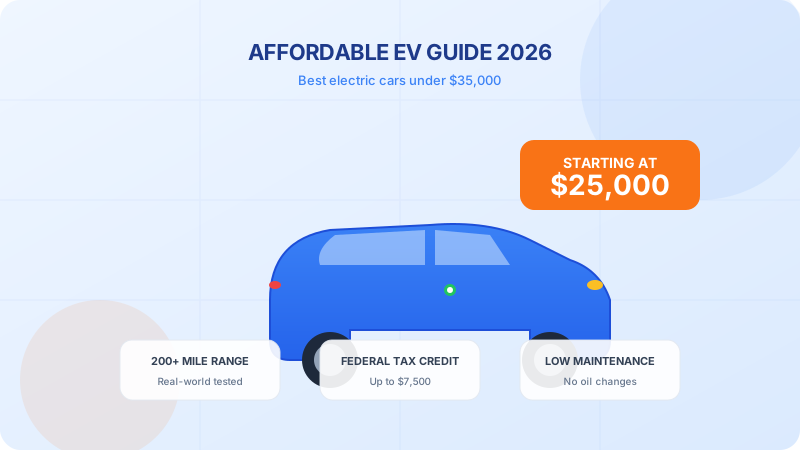
Finding a great electric vehicle without breaking the bank is easier than ever. While flagship EVs from Tesla and Rivian grab headlines, several excellent models deliver real electric range, modern tech, and low running costs for under $35,000. Whether you are buying your first EV or downsizing from a larger model, this guide breaks down the top affordable electric cars available in the United States today.
Why Buy an EV Under $35,000?
Entry-level EVs are no longer compromised machines with tiny batteries and sparse interiors. Advances in battery chemistry and manufacturing scale have brought usable 200-plus-mile range vehicles into the mid-$20,000 range after incentives. These cars make ideal commuters, second vehicles, or primary cars for urban and suburban drivers with predictable daily mileage.
Beyond the sticker price, owners save on fuel, maintenance, and in many states, registration fees. When you factor in the federal EV tax credit and local utility rebates, the total cost of ownership can undercut comparable gasoline cars within the first two years.
Top Affordable Electric Cars Compared
The table below compares the leading models under $35,000 based on MSRP, EPA-rated range, onboard charging speed, and eligibility for the $7,500 federal tax credit.
| Model | Starting MSRP | EPA Range | Max AC Charging | Tax Credit Eligible? |
|---|---|---|---|---|
| Chevrolet Bolt EUV | ~$27,800 | 247 mi | 11.5 kW (Level 2) | Yes |
| Nissan Leaf SV Plus | ~$28,140 | 212 mi | 6.6 kW (Level 2) | Partial* |
| Mini Cooper SE | ~$30,900 | 114 mi | 11 kW (Level 2) | Yes |
| Hyundai Kona Electric | ~$32,675 | 261 mi | 11 kW (Level 2) | Yes |
| Kia Niro EV | ~$34,750 | 253 mi | 11 kW (Level 2) | Yes |
| Chevrolet Equinox EV (1LT) | ~$34,995 | 250+ mi (est.) | 11.5 kW (Level 2) | Yes |
*The Nissan Leaf is assembled in Tennessee but may be subject to partial credit depending on current battery sourcing rules. Verify at fueleconomy.gov before purchase.
Chevrolet Bolt EUV
The Bolt EUV is the value champion. With 247 miles of range, spacious seating for five, and standard DC fast charging, it covers daily commuting and weekend trips without anxiety. The 11.5 kW onboard charger refills the battery in about seven hours on a Level 2 home charger. Super Cruise, GM’s hands-free highway driving system, is available on higher trims.
At roughly $27,800 before incentives, the Bolt EUV drops to just over $20,000 after the federal tax credit. That places it firmly in budget-hatchback territory while offering zero tailpipe emissions and far lower fuel costs.
Nissan Leaf SV Plus
The Leaf is the original mass-market EV, and the SV Plus trim finally delivers the range most drivers need. Its 212-mile rating suits suburban round-trip commutes, and the e-Pedal one-pedal driving system remains one of the smoothest in the industry.
The Leaf uses the CHAdeMO fast-charging standard, which is less common than CCS at newer stations. If you rely heavily on public road-trip charging, this can be a limitation. For home-based drivers, it is less of an issue. Build quality is solid, and the cabin is quiet and comfortable.
Mini Cooper SE
With only 114 miles of EPA-rated range, the Mini Cooper SE is not for everyone. But if your daily driving stays under 60 miles and you want the most fun-to-drive EV at this price, the Mini is unbeatable. Its instant torque, nimble chassis, and premium interior feel like a car from a higher segment.
The Mini is perfect for city dwellers with easy access to a home charger or public plugs at work. It qualifies for the full federal tax credit, which can bring the effective price close to $23,000.
Hyundai Kona Electric and Kia Niro EV
Hyundai and Kia share much of their EV technology, and both the Kona Electric and Niro EV deliver over 250 miles of range with modern interiors and excellent warranty coverage. The Kona is the sportier, smaller crossover, while the Niro offers more cargo room and a slightly more refined ride.
Both brands include 1,000 kWh of complimentary fast charging at Electrify America, worth roughly $400 in public charging credits. That is a real-world bonus for buyers who occasionally take longer trips.
Understanding Incentives and Rebates
The federal tax credit offers up to $7,500 for qualifying new EVs, but final eligibility depends on where the vehicle is assembled and where its battery minerals are sourced. As of mid-2026, all models in this list except the Nissan Leaf (partial) qualify for the full credit. Buyers should confirm current rules using the IRS Energy Credits Online tool.
Many states add their own rebates. California offers up to $7,000 through the Clean Vehicle Rebate Project. Colorado, New York, and Oregon also provide substantial incentives. Utility companies in Texas, Florida, and the Midwest frequently offer $500 to $1,000 rebates for EV purchases or home charger installations.
Consider the Used EV Market
If $35,000 is still too high, used EVs offer exceptional value. Three-year-old Chevrolet Bolts, Hyundai Konas, and Tesla Model 3s are widely available for $15,000 to $25,000. Battery degradation in modern liquid-cooled packs is minimal, often under 5 percent after five years. A used EV loses the new-car federal tax credit but still benefits from cheap fuel and low maintenance.
Before buying used, verify the remaining battery warranty. Federal law requires manufacturers to cover EV batteries for at least eight years or 100,000 miles. Check the battery health report from a dealer or third-party inspection service.
Key Takeaway: Do the Total Cost Math
Do not compare EVs to gasoline cars using sticker price alone. A $28,000 Bolt EUV becomes roughly $20,500 after the federal credit. Add state rebates and lower fuel costs, and the effective first-year price can match a $17,000 gasoline hatchback. Use our home charging cost guide to estimate your exact monthly savings.
Which Affordable EV Should You Buy?
Choose the Chevrolet Bolt EUV for maximum range per dollar. Choose the Mini Cooper SE if you prioritize driving fun and rarely exceed 80 miles in a day. Choose the Hyundai Kona Electric or Kia Niro EV if you want the longest range and best warranty in this price bracket. And if budget is the absolute priority, consider a certified pre-owned EV to unlock sub-$20,000 ownership without sacrificing modern technology.